What Telecom Operators Don’t See: Inside a 6,400-Tower Drone Inspection Operation
How FlyGuys pilots Paul and Tara Carrin plan, capture and deliver cell tower data so multi-site programs stay on schedule.
Summary
A tower inspection looks like a drone flight. For the pilots who run it, the flight is one step in a longer chain: reading site notes, routing dozens of sites, checking in with the network operations center, capturing ground equipment, and packaging files for engineers.
Paul and Tara Carrin have completed 6,400 cell tower inspections since July 2021, 33 of them for FlyGuys. Working from a converted box truck, they routinely complete 8-10 manual flights or 4-6 automated flights on a good day and forecast their schedules tightly enough that operators can plan construction around them.
This case study walks through how they do it, including two difficult projects flown for other clients. The lessons apply to any operator running a multi-site program and to any pilot learning tower work: automation helps, but planning, judgment and organization are what keep data on schedule.
The Challenge: What slows down multi-site cell tower inspections?
Multi-site tower programs depend on capture that is accurate, safe, and on time across sites that are spread out and rarely alike. Four problems put that at risk:
- Site notes are easy to miss. A site may need 24-hour notice, or a key collected from another location first. Pilots who skip the notes lose days.
- Schedules collide with geography. Priority sites are often at opposite ends of a route. At current fuel prices, Tara notes, a 10-mpg truck can’t cross a state for one site and stay profitable.
- Shared towers and tight rules complicate capture. One tower may carry several carriers’ equipment, and pilots may not touch cables or fiber even when they block a barcode.
- Automated flight has limits. Guyed wires, trees, birds, power lines, neighboring towers, and rooftops can make an automated path unsafe or incomplete.
Each problem delays the engineers and construction crews waiting on the data.


The Solution: How do experienced pilots keep tower programs on schedule?
Paul and Tara’s approach rests on five habits most operators never see.
1. Read every note before routing
When a new program arrives, Tara runs the site notes through a spreadsheet to pull out keywords that signal trouble: advance-notice requirements, keys held at another site, access restrictions. Anything unclear gets a follow-up before they leave. “Flying by the seat of your pants bites you,” Paul said. “If you really want to get nine out of 10 of these sites, you have to check the notes thoroughly.”
2. Route for real-world conditions
Tara builds each day in the client’s CRM routing tool, estimating time on site from the tower type and capture method. She adds time for steep four-wheel-drive climbs and for a truck that never exceeds 65 mph. The result is a forecast operators can rely on, often to the exact number of sites per day.
3. Check in, stay hands-off, check out
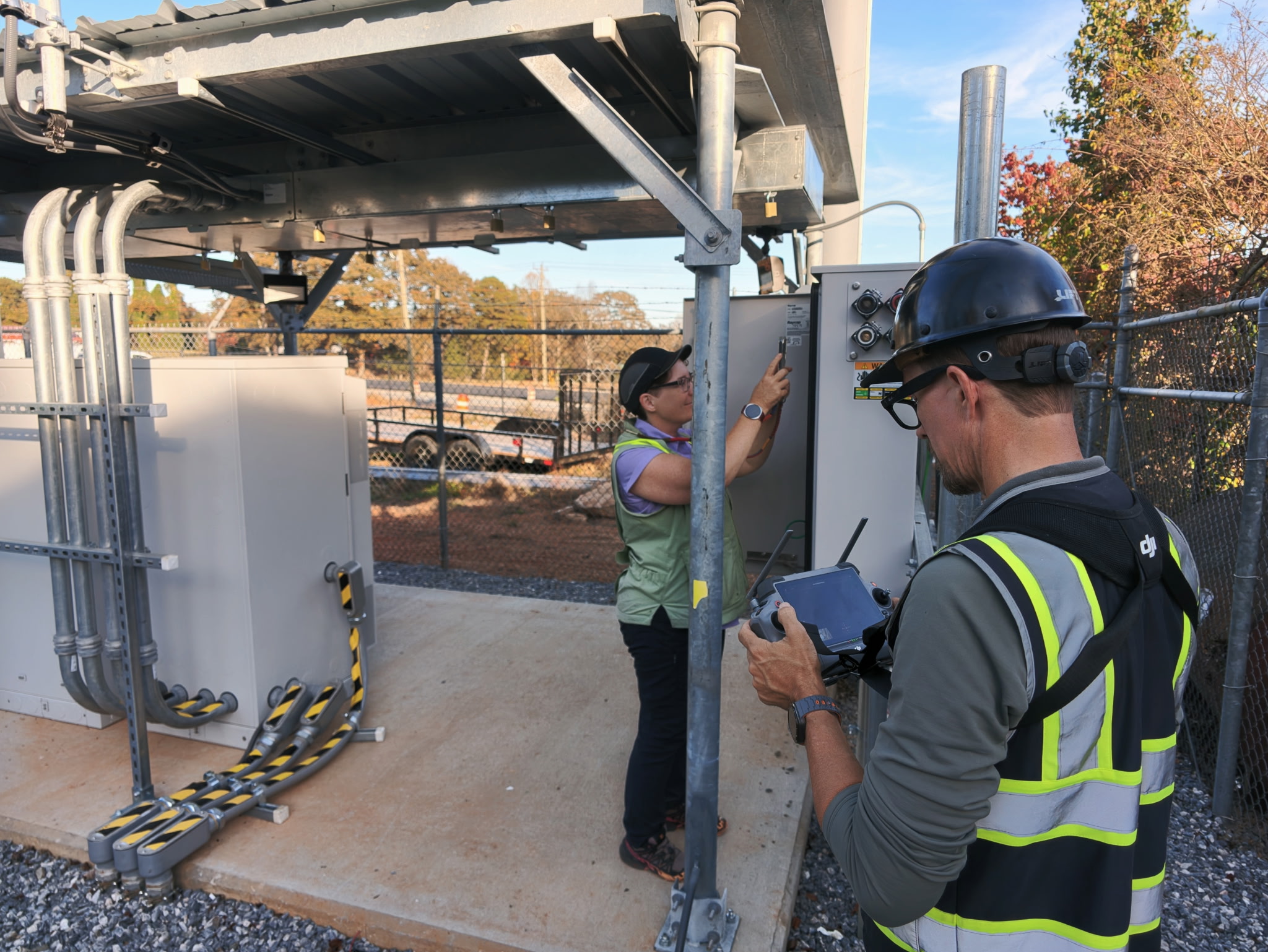
On arrival, Tara checks in on the client’s portal (FlyGuys’ included) and with the carrier’s network operations center so equipment alarms are suppressed. Pilots photograph equipment without touching cables or fiber. Before leaving, she checks out and confirms no alarms were triggered.
4. Work in parallel
| Stage | Paul | Tara |
| Arrival, ideally before sunrise | Launches the aerial capture | Starts ground equipment photos |
| During flight | Flies, or monitors an automated flight while starting the 3D scan | Completes paperwork, tags and uploads ground photos |
| After landing | Finishes the 3D scan, hands over the SD card | Sorts flight images into the client’s folder structure and uploads |
During manual flights, Paul logs a quick keyword at each transition (“down orbit,” “up orbit”) so Tara can sort hundreds of images without searching through them.
5. Finish early to leave room for Quality Assurance
Every client works to an alliance due date. Paul and Tara aim to deliver well ahead of it so the coordinating company, FlyGuys on their FlyGuys projects, has time to review the data before it goes to the end client.

Implementation Process: What happens when a tower inspection doesn’t go to plan?
Both projects below come from Paul and Tara’s broader telecom career and were flown for other clients, not FlyGuys. They show the judgment and planning the team now brings to every program, including their FlyGuys work.
Paul: when the automated flight had to stop
Paul was capturing a four-anchor guyed tower with the automated flight software the client required. The quality assurance lead from a major telecom equipment vendor was on site to watch the software work.
The software was supposed to route around the marked anchors, but it couldn’t calculate the guy wires. Attempt after attempt, it steered the drone toward the tower or into the wires, nearly crashing each time. With the vendor watching, Paul made the call to stop and fly the tower manually.
Later that day, the tower owner’s representative stopped by and confirmed Paul’s conclusion: software couldn’t safely fly a four-anchor guyed tower.
Tara: 40 urgent sites and no advance notice
Tara’s hardest project was 40 pre-construction sites on Oahu, Hawaii. The client had stressed urgency: engineering plans and construction crews were waiting on the imagery.
About a third of the sites were on Army, Marine Corps, Navy and Air Force installations. Everyone required advance notice from the carrier, and none had been sent. “No one knew anything about us coming, and that makes it really hard to plan an efficient route,” Tara said.
Without confirmed access, she couldn’t lock daily routes, which meant finding extra lodging and rental cars mid-trip. The team adapted, updating forecast dates as the schedule shifted so the client always knew when to expect data.
“Like most of the challenges we run into in the field, we were able to find a way to get the sites done within a reasonable time frame,” Tara said. “We were able to meet wonderful people throughout the different branches of the military who bent over backwards to help us move the project forward.”
OUTCOME
Results & ROI
- Towers completed: 6,400 since July 2021
- Towers flown for FlyGuys: 33
- Daily output: 5-6 automated flights at closely located sites on a good day; record of 21 on a manual/hybrid profile with closely spaced sites
- Time on site, monopole: About 45 minutes
- Time on site, 450-ft guyed tower: About 2.5 hours automated; 50–60 minutes manual where the client allows it
- Equipment alarms left on after a site: None
- Forecast accuracy: Daily site counts planned closely enough to keep client forecasts current
Get A Quote
Take Your Project To New Heights
No matter where your project is located, FlyGuys connects you with certified, FAA-compliant drone pilots ready to capture the data you need—quickly, safely, and reliably.
Request a quote today and let our team match you with the right drone solution for your project.
Please note that we are currently unable to assist in the search for missing pets. This limitation is due to the specific challenges and regulations associated with using drones for such purposes.